
 By
ByIf you have been following the AI space, you already know Claude by Anthropic is one of the most talked-about AI tools right now. But 2026 has been a particularly big year for Claude AI 2026. In the first quarter alone, Anthropic shipped more meaningful updates than most AI companies release in a full year.
From brand new model generations and a 1 million token context window to autonomous computer use and a completely new agentic workflow platform, Claude in 2026 looks very different from what it was even six months ago.
This guide covers every major Claude AI advancement in 2026 — explained in plain language without jargon. Whether you are a designer, a developer, a business owner, or just someone curious about AI, this breakdown will tell you exactly what is new and why it matters.
Claude AI Model Family in 2026 — Overview
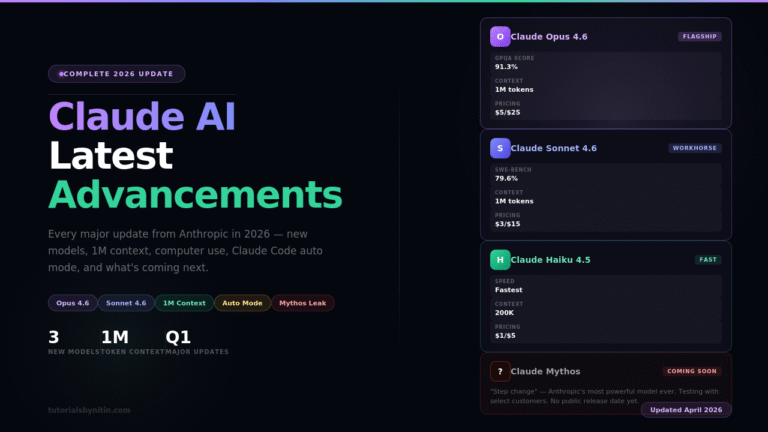
Anthropic currently offers three main models in the Claude 4.x generation as of early 2026. Each is designed for a different type of user and use case.
Claude Opus 4.6 — The flagship model. Maximum reasoning power, ideal for complex analysis, research, and enterprise workloads. Most expensive but most capable.
Claude Sonnet 4.6 — The workhorse. Near-Opus performance at a fraction of the cost. The recommended choice for most developers and production applications.
Claude Haiku 4.5 — The speed model. Fastest and most affordable. Best for high-volume tasks where response time and cost matter more than depth.
A fourth model, Claude Sonnet 5 (codenamed “Fennec”), released in early 2026 for developers with cutting-edge coding needs. And a fifth, Claude Opus 5, is expected later in 2026.
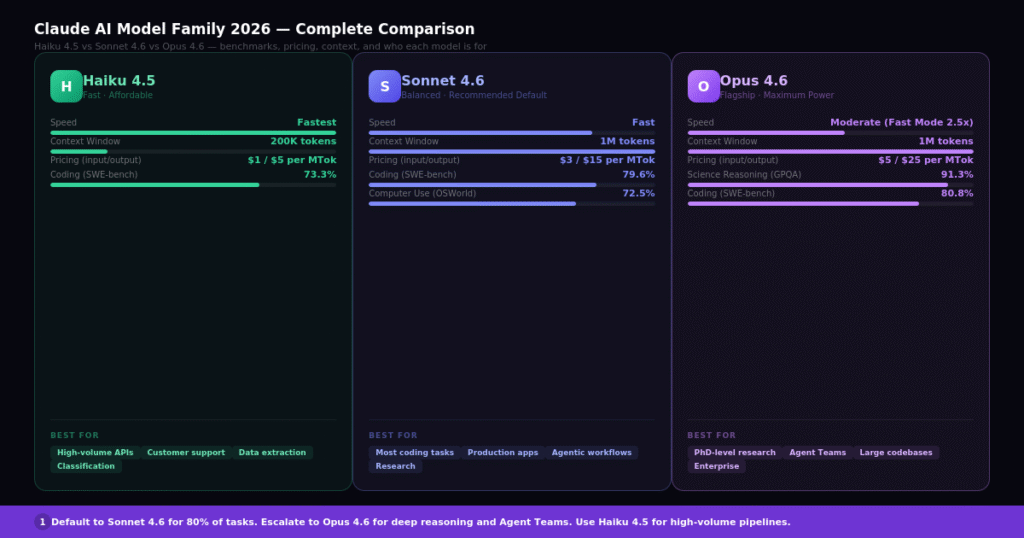
Claude AI model family in 2026 — Haiku 4.5, Sonnet 4.6, and Opus 4.6 compared across capability, speed, and cost.
Claude Opus 4.6 — Anthropic’s Most Powerful Model
Claude Opus 4.6 was released on February 3, 2026. It is Anthropic’s flagship model and currently one of the most capable AI models available to the public.
What makes it special:
Opus 4.6 scores 91.3% on GPQA Diamond — a benchmark that tests PhD-level reasoning in biology, chemistry, and physics. According to Anthropic, this is the highest published score for any commercial AI model on this benchmark as of its release date.
On SWE-bench Verified, which measures the ability to resolve real GitHub issues end-to-end, Opus 4.6 scores 80.8%. This places it at the top of real-world coding performance.
1 million token context window: Opus 4.6 supports a context window of up to 1 million tokens at standard pricing (more on this below). That is enough to read an entire book, a full codebase, or hundreds of research papers in a single conversation.
Extended thinking and Agent Teams: Opus 4.6 supports extended thinking, where the model reasons through complex problems step by step before answering. It also introduces Agent Teams — the ability to split a complex task into subtasks, work on them in parallel, and combine the results.
Fast mode: A new Fast Mode for Opus 4.6 delivers output up to 2.5x faster at premium pricing. This is the same model running with faster inference — no change in intelligence — useful for time-sensitive production pipelines.
Pricing: $5 per million input tokens, $25 per million output tokens. This is a 67% cost reduction compared to previous flagship generations.
Claude Sonnet 4.6 — The New Workhorse
Released on February 17, 2026, Claude Sonnet 4.6 has quickly become the go-to model for most developers and businesses. The reason is simple: it delivers 98% of Opus 4.6’s performance on coding and computer use at one-fifth the cost.
On SWE-bench Verified, Sonnet 4.6 scores 79.6% — just 1.2 points behind Opus 4.6’s 80.8%. On OSWorld (computer use), it scores 72.5% versus Opus 4.6’s 72.7%. For most practical development work, the difference is negligible.
In internal Claude Code testing at Anthropic, developers preferred Sonnet 4.6 over the previous flagship Opus 4.5 59% of the time. That tells you a lot about how much the model has improved.
Also read: Seedance 2.0
Key capabilities:
- 1 million token context window at standard pricing (available from March 2026)
- 64,000 maximum output tokens per response
- Extended thinking and adaptive reasoning
- Strong math performance — 89% on math benchmarks, a 27-point jump from Sonnet 4.5
- Full computer use and agentic capabilities
Pricing: $3 per million input tokens, $15 per million output tokens. For a sense of scale, processing one million tokens at these rates costs about $3 — roughly the same as a cup of coffee.
The practical guidance from Anthropic is to use Sonnet 4.6 as your default for most tasks, and escalate to Opus 4.6 only when you need the deepest scientific reasoning, Agent Teams, or you are analysing very large codebases.
Claude Haiku 4.5 — Fast, Affordable, and Surprisingly Capable
Claude Haiku 4.5 is Anthropic’s fastest and most affordable model. At $1 per million input tokens and $5 per million output tokens, it is designed for high-volume tasks where speed and cost efficiency matter more than maximum reasoning depth.
What is surprising about Haiku 4.5 is how capable it is for its price point. Anthropic says it matches Claude Sonnet 4’s performance on coding, computer use, and agentic tasks — despite being a much smaller, faster model.
Haiku 4.5 is ideal for customer support automation, content classification, data extraction, content moderation, and any pipeline that processes thousands of requests per minute.
1 Million Token Context Window — What It Actually Means
One of the most significant Claude AI 2026 updates is the move to a 1 million token context window at standard pricing for both Opus 4.6 and Sonnet 4.6, announced on March 13, 2026.
To understand why this matters, it helps to know what a “token” is. Roughly speaking, 1 token equals about 0.75 words in English. So 1 million tokens is approximately 750,000 words — which is longer than most novels, larger than most company codebases, and enough to hold hundreds of research papers.
Before this update: Using a very long context in Claude cost significantly more. Prompts exceeding 200,000 tokens were charged at double the standard input rate for Sonnet. This made large-scale document analysis expensive.
After March 2026: Both Opus 4.6 and Sonnet 4.6 process up to 1 million tokens at standard pricing. A 900,000-token request costs the same per-token rate as a 9,000-token request. The surcharge is gone.
What this enables in practice: A lawyer can upload an entire multi-year contract history and ask Claude to find inconsistencies. A developer can load a full enterprise codebase and ask Claude to understand and refactor it. A researcher can feed Claude 200 papers and ask for cross-cutting insights. None of this was practically affordable before.
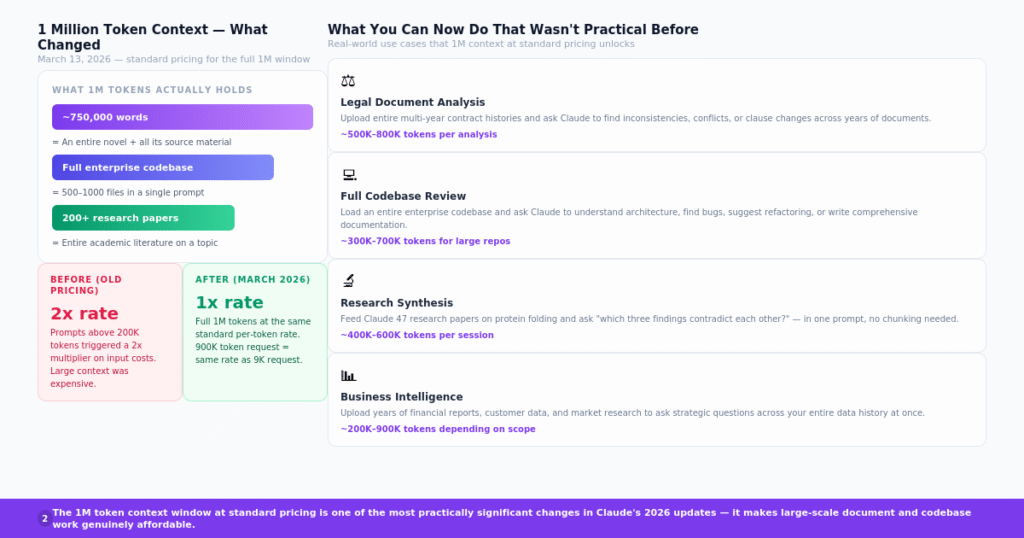
1 million token context window — what it means in real-world terms and how pricing changed in March 2026.
Claude Code — From Coding Assistant to Autonomous Agent
Claude Code started as a command-line AI coding assistant. By March 2026, it has evolved into something much more significant — a full autonomous coding agent platform.
Here are the major updates Claude Code received in 2026:
Auto Mode (Research Preview — March 2026)
Auto mode lets Claude Code execute tasks with fewer interruptions. Instead of asking for your approval at every step, Claude uses an AI safety layer to determine which actions are safe to run automatically and which ones need human confirmation.
This eliminates the constant back-and-forth that developers described as “babysitting the model.” You can start a long refactoring task, come back in 30 minutes, and find it done rather than paused waiting for your approval.
Auto mode currently works with Claude Sonnet 4.6 and Opus 4.6. Anthropic recommends using it in isolated sandbox environments rather than directly in production systems.
Claude Code Review
Before auto mode launched, Anthropic introduced Claude Code Review — an automatic code reviewer that catches bugs before they hit the production codebase. Combined with auto mode, the workflow becomes: Claude writes code, Claude reviews it for bugs, Claude executes the safe parts.
Scheduled Tasks (/loop)
Claude Code can now run recurring tasks on a schedule, similar to cron jobs. You can set Claude to run a security audit every Monday morning, generate test coverage reports after each deployment, or produce pull request summaries every Friday — all without any manual trigger.
Remote Access
You can start a Claude Code session on your computer and then monitor and continue it from your phone or any browser. The code never leaves your machine — only the chat messages travel through an encrypted channel.
Agent Sub-Tasks
Claude Code can now split complex tasks into subtasks and run them in parallel in the background. You can start a research task, keep working on something else, and Claude will return the results when it is done.
Claude Cowork — AI for Non-Developers
Not everyone lives in a terminal or code editor. Claude Cowork, launched on January 12, 2026, brings Claude Code’s agentic capabilities to knowledge workers who use everyday productivity tools.
The concept is simple. You grant Claude access to a folder on your computer. You describe a task in plain language. Claude reads the files in the folder, does the work, and produces deliverables in the same folder.
Tasks Claude Cowork handles include restructuring messy file systems, pulling data from screenshots and PDFs into spreadsheets, drafting reports by synthesizing scattered documents, generating presentation slides from raw notes, and filling in client briefs from email threads.
Anthropic’s Head of Enterprise called it “vibe working” — the non-developer equivalent of vibe coding. The same way non-technical people can describe a web app and have AI build it, knowledge workers can describe a deliverable and have Claude produce it.
In March 2026, Cowork added the ability to create and schedule both recurring and on-demand tasks, and a new Dispatch feature that lets you send tasks to Claude from your phone while it executes on your desktop.
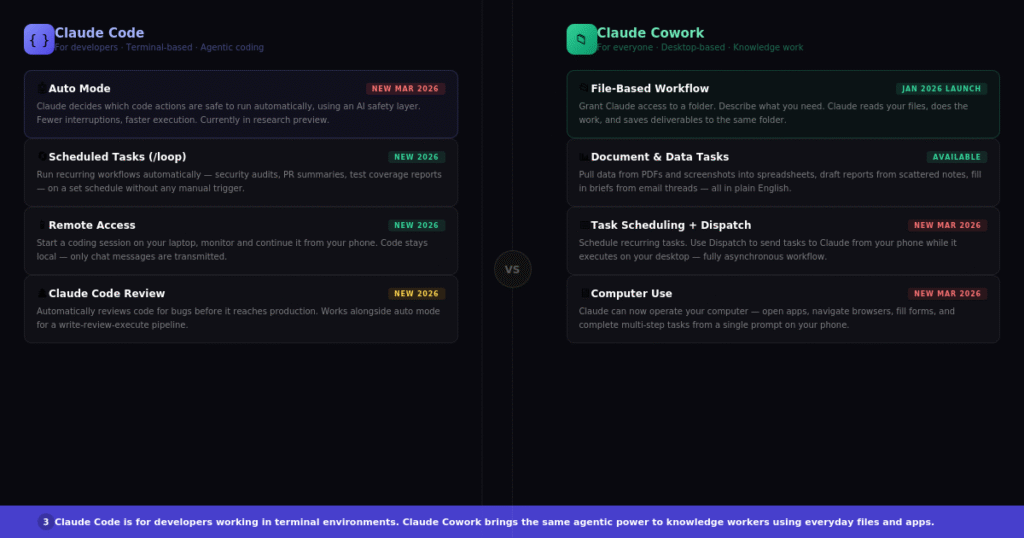
Claude Cowork vs Claude Code — what each product does and who it is built for.
Computer Use — Claude Can Now Operate Your PC
In late March 2026, Anthropic launched computer use for Claude — the ability to actually control your computer to complete tasks.
This means Claude can open applications, navigate your browser, fill in spreadsheets, export documents, and handle multi-step tasks that previously required you to be at the keyboard for every step.
One example Anthropic demonstrated: a user running late for a meeting messages Claude from their phone asking it to export a pitch deck as a PDF and attach it to the meeting invite. The video shows Claude opening the file, exporting it, and attaching it to the calendar event — all without the user touching their computer.
Other tasks computer use can handle include filling out online forms, organizing files, compiling data from multiple websites into a spreadsheet, and managing email.
Anthropic is clear that computer use is still in early stages compared to Claude’s text and coding capabilities. Claude can make mistakes. It requests permission before accessing new applications. And Anthropic recommends using it carefully for now, particularly with sensitive data or financial tasks.
Claude’s Expanded Constitution — AI Safety Gets More Nuanced
One of Claude’s defining characteristics has always been its approach to safety and ethics. In January 2026, Anthropic made a significant update to what they call Claude’s “constitution” — the set of principles that guide how Claude reasons about its behavior.
The original constitution from 2023 was about 2,700 words. The 2026 version expanded it to 23,000 words. This is not simply more rules. It is detailed reasoning context — explanations of why certain principles exist, how to weigh competing values, and how to apply judgment in genuinely novel situations.
The goal is to move Claude away from pattern-matching to simple rules and toward something closer to genuine ethical judgment. Instead of checking prompts against a list of prohibited topics, Claude reasons about its behavior the way a thoughtful person would.
In practical terms, users have noticed that Claude in 2026 is more nuanced in how it handles ambiguous situations — less likely to refuse things it should help with, and better at explaining its reasoning when it does decline.
Claude Mythos — The Next Major Model (What We Know)
In late March 2026, Fortune magazine reported on a data leak from Anthropic’s systems — a draft blog post that appeared to describe a new model called Claude Mythos.
Anthropic confirmed the model’s existence, calling it “by far the most powerful AI model we’ve ever developed” and describing it as a “step change” in capabilities rather than an incremental improvement.
Anthropic said Mythos has “meaningful advances in reasoning, coding, and cybersecurity” and that they are being deliberate about release because of the strength of its capabilities. A small group of early access customers is currently testing it.
What we do not know yet is the release date, pricing, or the full capability profile. But the language Anthropic has used suggests Mythos represents a more significant generational leap than the 4.5 to 4.6 update — potentially comparable to the step from Claude 3 to Claude 4.
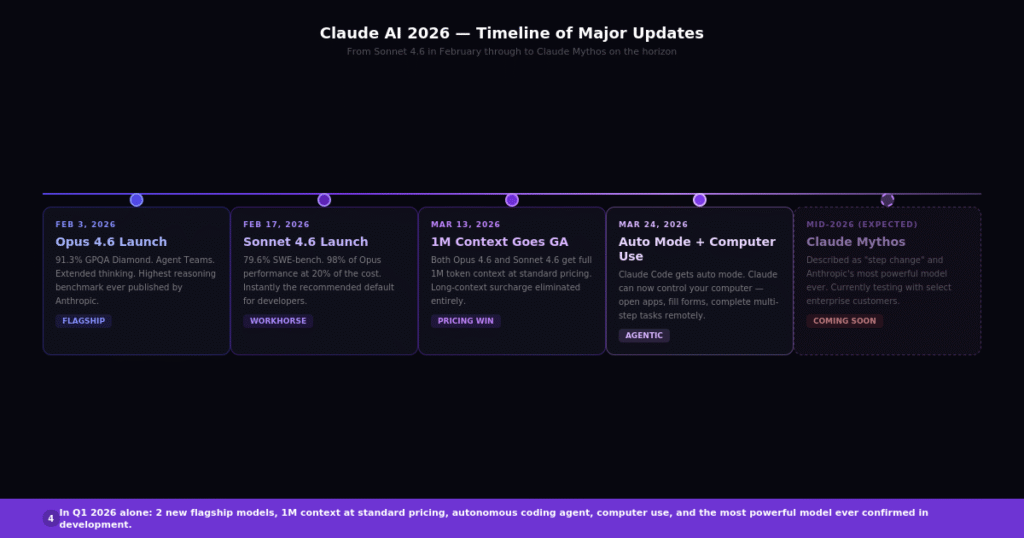
Claude AI 2026 timeline — from Sonnet 4.6 in February through to Claude Mythos on the horizon.
How to Access Claude in 2026
There are several ways to access Claude depending on your needs.
Claude.ai (Web and Mobile) — The main consumer interface. Free plan gives you limited access to Claude Sonnet 4.6. Pro plan ($20/month) gives expanded access to Sonnet 4.6 and Opus 4.6. Max plan gives the highest usage limits and access to Claude’s memory features.
Claude Desktop App — Available for macOS and Windows. Required for Claude Cowork and certain agentic features. Free to download.
Claude Code — The command-line AI coding tool. Available to Team and Enterprise plan subscribers, and now included with every Team plan standard seat.
Claude in Chrome — A browser extension that lets Claude see and interact with web pages. Available to paid subscribers.
Claude for Excel and PowerPoint — AI add-ins that bring Claude into your spreadsheet and presentation workflows. Can now share context across both apps in the same conversation.
Claude API — For developers building applications on top of Claude. Access to all models including Opus 4.6, Sonnet 4.6, and Haiku 4.5.
Claude AI vs ChatGPT in 2026 — Quick Comparison
Both Claude and ChatGPT are strong AI assistants in 2026, but they have different strengths.
Claude’s advantages: More nuanced safety reasoning, better performance on long documents, stronger constitutional AI framework, superior coding and computer use benchmarks on SWE-bench and OSWorld, 1 million token context at standard pricing, and the integrated Claude Code ecosystem for developers.
ChatGPT’s advantages: Native image generation (Claude does not generate images), voice mode, broader consumer awareness, and deep integration with the Microsoft ecosystem.
For writing, coding, research, and document analysis, Claude tends to come out ahead in head-to-head evaluations in 2026. For creative image generation and voice interaction, ChatGPT has features Claude lacks.
Subscribe for Newsletter

