
 By
ByThe Tesla Cybercab investigation started on September 4, 2026, when the National Highway Traffic Safety Administration opened a federal audit query into Tesla’s steering-wheel-free robotaxi, one day after the vehicle began carrying paying riders in Austin, Texas. NHTSA wants to know whether Tesla’s own compliance testing actually proves the car meets federal safety rules.
What Triggered the Tesla Cybercab Investigation?
NHTSA opened its review within a day of the Cybercab’s commercial launch, a turnaround fast enough to suggest the agency had concerns queued up before the first ride even happened. The trigger was structural, not incidental: the Cybercab ships with no steering wheel, no brake pedal, no accelerator pedal, and no traditional side mirrors, features that every prior passenger car sold in the United States has been required to include.
Tesla launched the service on September 3, 2026, sending a small fleet of the two-seat vehicles onto Austin streets after a launch event for invited riders. According to TechCrunch’s reporting from September 4, 2026, federal regulators moved almost immediately, unconvinced that Tesla’s internal certification process was enough to prove the vehicle met the rules it claimed to satisfy.
That speed is unusual. Most vehicle compliance questions surface gradually, through owner complaints, crash reports, or routine spot checks long after a model has been on sale. Here, NHTSA acted before a single week of commercial service had passed, which suggests the agency had already flagged the Cybercab’s design during Tesla’s pre-launch testing period in Austin and was simply waiting for the commercial deployment to formalize its request.
What Is the Timeline of the Tesla Cybercab Launch and Investigation?
- Late August 2026: Unsupervised Cybercabs are spotted testing on Austin streets ahead of a public launch
- September 3, 2026: Tesla holds a launch event in downtown Austin and begins offering paid Cybercab rides
- September 4, 2026: NHTSA opens audit query AQ26002 into the Cybercab’s FMVSS self-certification
- September 2026 onward: Tesla compiles and submits certification documentation while the Cybercab fleet keeps operating in Austin
What Is NHTSA’s Audit Query AQ26002?
Audit query AQ26002 is a formal information request, not a recall or a stop-sale order. NHTSA is asking Tesla to hand over the engineering data and reasoning behind its decision to treat certain Federal Motor Vehicle Safety Standards, or FMVSS, as not applicable to the Cybercab’s design. The agency’s own filing, published through its Office of Defects Investigation, frames the question narrowly: how much of Tesla’s certification rested on the assumption that specific FMVSS rules simply do not apply to a car built without manual controls.
The scope is not small. NHTSA’s official press release on the investigation confirms the audit query covers an estimated 1,000 Cybercab vehicles, the size of the fleet Tesla has registered for the Austin rollout as of September 2026. An audit query is an investigative step rather than an enforcement action, so it does not itself ground the fleet or halt rides while it is open.
NHTSA administrator Jonathan Morrison framed the review as a compliance check rather than an attack on autonomous vehicles: “NHTSA fully supports the safe development and deployment of automated vehicles. But as the federal regulator, we need to ensure that all of our laws are followed,” he said in the agency’s September 2026 statement. Tesla, for its part, told NHTSA the Cybercab meets “all applicable” federal safety standards, the exact claim the audit query is now checking line by line.
What Is NHTSA Actually Asking Tesla to Provide?
Audit queries typically request a specific set of materials so investigators can reconstruct how a manufacturer reached its certification decision. For the Cybercab, that record is expected to include:
- Documentation showing which FMVSS provisions Tesla determined were inapplicable, and the legal or engineering basis for each determination
- Internal test data supporting the self-certification decision on crash protection, occupant restraint, and visibility standards
- A design comparison between the Cybercab and Tesla’s conventional passenger vehicles, explaining every control that was removed
- Evidence that remote monitoring or in-vehicle safety systems compensate for the missing manual override controls
Why Doesn’t the Cybercab Have a Steering Wheel or Pedals?
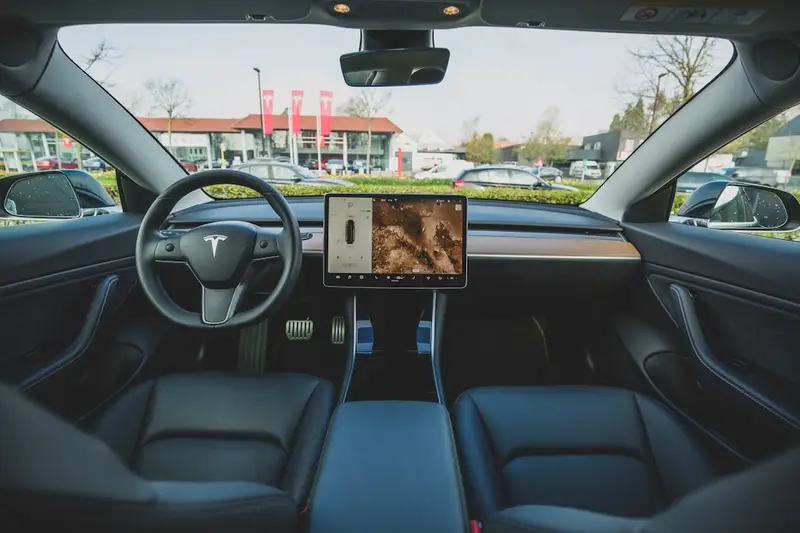
Tesla designed the Cybercab as a purpose-built robotaxi rather than a modified consumer car, betting that removing manual controls entirely would cut manufacturing cost and signal that the vehicle never needs a human backup driver. The two-seat cabin has no dashboard cluster for steering input and no floor pedals, so every function a driver would normally handle, acceleration, braking, and steering, runs through Tesla’s Full Self-Driving software stack with no manual override path built into the hardware.
That design choice is exactly why FMVSS compliance became complicated. Nearly every existing federal motor vehicle safety standard for passenger cars, from steering column crash behavior to pedal placement, assumes a human sits in the driver’s position with a wheel and pedals in front of them. A car built without those parts cannot simply be tested against those specific rules; the manufacturer has to argue the rule does not apply to this design at all, which is precisely the reasoning NHTSA’s audit query is scrutinizing.
How Does Tesla’s Full Self-Driving Software Replace a Human Driver?
The Cybercab runs on the same Full Self-Driving neural network stack Tesla has spent years training on camera data from its consumer vehicle fleet, but in the Cybercab it operates without a human safety net of any kind. Existing Tesla robotaxis in Austin still carry a safety monitor in the passenger seat who can intervene verbally or, in some builds, through a limited control interface. The Cybercab removes that role entirely, so the software’s perception, prediction, and planning systems have to handle edge cases, construction zones, emergency vehicles, and unpredictable pedestrians, with no person on board able to take over.
That is also why the certification question is not just paperwork. NHTSA’s rules assume a human can always regain control in an emergency, which is the entire reason steering wheels, brake pedals, and mirrors exist as legal requirements in the first place. Removing them only makes sense if the software is trusted to be the sole line of defense, and proving that trust is warranted is a much higher bar than proving a car’s crumple zones meet spec.
How Did Tesla Certify the Cybercab as Road-Legal?
Tesla used self-certification, the standard path under U.S. federal law that lets a manufacturer test its own vehicle, decide which FMVSS rules apply, and certify compliance without pre-approval from NHTSA. Before the Cybercab launch, Tesla stated publicly that it had relied on this process to confirm the vehicle met applicable safety standards. Self-certification is legal and is how the overwhelming majority of vehicles reach American roads, but it places the burden of getting the interpretation right entirely on the manufacturer.
NHTSA’s audit query signals the agency is not simply taking that self-certification at face value for a vehicle this far outside the norm. The agency can, and does, go back after the fact to check a manufacturer’s homework, and a design with no steering wheel is an obvious candidate for that kind of review.
Has Tesla’s Austin Robotaxi Service Had Safety Problems Before?
Yes, and that history is part of why the Cybercab investigation is drawing extra scrutiny. Tesla’s existing Austin robotaxi service, which uses modified Model Y vehicles with a safety monitor onboard, has been involved in 14 crashes since it launched in 2025, according to data Tesla disclosed to federal regulators and reported by CBS News in 2026. Two of those incidents caused minor injuries; the rest involved property damage with no injuries reported.
Separately, videos have surfaced showing individual Tesla robotaxis driving the wrong way down a street, braking hard for stationary police vehicles, and, as recently as August 2026, driving through a row of bollards while operating without a safety monitor onboard. None of those incidents are part of audit query AQ26002 directly, since AQ26002 is narrowly about the Cybercab’s certification paperwork, but they form the backdrop NHTSA is reviewing that paperwork against.
How Does the Cybercab Compare to Other Robotaxis Without Steering Wheels?
Tesla is not the first company to build a robotaxi without manual controls, but it took a different regulatory route to get there than its main rival. Amazon-owned Zoox petitioned NHTSA directly for a formal exemption before deploying its own steering-wheel-free vehicle, a process that, according to Tech Times’ September 2026 reporting, took roughly four years from petition to approval. Waymo, by contrast, still operates modified Jaguar I-Pace vehicles that retain a steering wheel and pedals, sidestepping the exemption question entirely even though no human drives them on public rides.
| Robotaxi | Steering Wheel & Pedals | Regulatory Path Used |
|---|---|---|
| Tesla Cybercab | None | Manufacturer self-certification |
| Amazon Zoox | None | Formal NHTSA exemption petition (~4 years) |
| Waymo (Jaguar I-Pace fleet) | Retained | Standard FMVSS compliance, no exemption filed |
That contrast is the core of why the Cybercab investigation matters. Zoox spent years in a formal, pre-approved exemption process precisely because regulators wanted to examine a wheel-free design before it carried passengers. Tesla skipped that step and self-certified instead, betting NHTSA would accept its own interpretation of which rules apply. The audit query is NHTSA checking that bet after the fact rather than before.
What Happens Next in the Tesla Cybercab Investigation?
An audit query is the earliest stage of NHTSA’s investigative process, and it can end in a few different ways. NHTSA may review Tesla’s submitted documentation and close the query with no further action, escalate it into a formal Preliminary Evaluation if the answers raise new concerns, or, in a worst case for Tesla, move toward a noncompliance finding that forces a recall or design change. There is no fixed public deadline for Tesla’s response, and NHTSA has not signaled how long its review will take.
Crucially, the Cybercab fleet keeps running in Austin while the audit query is open. Regulators reserve fleet groundings for cases with an immediate, demonstrated safety defect, and an information request about certification paperwork does not meet that bar on its own.
Past audit queries into other manufacturers give a rough sense of pacing: some close within a few months once a company submits satisfactory documentation, while others stretch past a year if NHTSA keeps requesting follow-up data or opens a broader Preliminary Evaluation. Given the Cybercab is the first mass-market vehicle sold in the U.S. without any manual controls at all, this case has few direct precedents, which makes a fast resolution less likely than it would be for a more conventional compliance question.
How Does the Cybercab Fit Into Tesla’s Robotaxi Business Strategy?
Tesla is launching the Cybercab into a market where Waymo already runs paid driverless rides in multiple U.S. cities and Baidu’s Apollo Go operates at scale in China, so timing matters as much as design. A purpose-built, steering-wheel-free vehicle is cheaper to manufacture at volume than retrofitting existing passenger cars, which is the same cost logic that pushed Zoox toward its own wheel-free design years earlier. Tesla’s bet is that skipping the multi-year exemption process Zoox went through, and self-certifying instead, gets Cybercabs on the road faster, even if it means absorbing a NHTSA audit query as the cost of moving first.
That trade-off is now playing out in public. Every week the audit query stays open without escalating is a week Tesla can point to as evidence its approach works; every new incident report from the existing Austin fleet gives NHTSA more reason to look harder at the Cybercab’s paperwork before letting the fleet grow beyond its current size.
What Should Riders and Investors Know Right Now?
Riders in Austin can still book Cybercab trips today; the service has not been paused, and nothing in the audit query changes how the vehicle operates in the short term. Anyone booking a ride should still treat it like any early-stage autonomous vehicle service: a newly launched fleet, in a single city, under active federal review. That does not mean the ride is unsafe, but it does mean the vehicle’s compliance paperwork has not yet been independently confirmed by the agency responsible for checking it.
For investors and industry watchers, the audit query adds a concrete regulatory risk to Tesla’s robotaxi rollout timeline. A quick, clean resolution would validate Tesla’s self-certification approach for future wheel-free designs. A drawn-out review, or an escalation to a full investigation, would raise the cost and time needed to scale the Cybercab fleet beyond Texas, and could influence how other manufacturers approach FMVSS exemptions for driverless vehicle designs going forward.
Anyone tracking Tesla stock or the broader robotaxi sector should watch for two signals in particular: whether NHTSA requests any documentation beyond what Tesla has already submitted, and whether the Cybercab fleet size in Austin grows or stays flat while the audit query remains open. A fleet expansion during an open query would be a strong signal Tesla and NHTSA are on good terms; a frozen fleet size would suggest the opposite.
This is one of several major stories moving fast in AI and tech this month, alongside Nvidia’s Hugging Face acquisition, OpenAI’s GPT-6 Astra launch, and a leadership change covered in our John Ternus Apple CEO guide. Chip supply is shifting too, as detailed in our Google Marvell chip deal breakdown.
Frequently Asked Questions About the Tesla Cybercab Investigation
Is the Tesla Cybercab still operating in Austin?
Yes. NHTSA’s audit query is an information request, not a stop-sale order or recall, so Tesla’s Cybercab fleet has continued carrying riders in Austin while the review is open.
What does NHTSA audit query AQ26002 actually mean?
AQ26002 is the case number for NHTSA’s formal request that Tesla explain and document how it decided certain federal safety standards do not apply to the Cybercab’s steering-wheel-free design.
Does the investigation mean Tesla broke the law?
No. An audit query does not allege a violation. It is a fact-finding step that lets NHTSA verify a manufacturer’s self-certification before deciding whether any further action is warranted.
How many Cybercabs are affected by the investigation?
NHTSA’s audit query covers an estimated 1,000 Cybercab vehicles, matching the size of the fleet Tesla registered for its Austin launch in September 2026.
How is the Cybercab different from a Tesla with Full Self-Driving?
A Tesla with Full Self-Driving still has a steering wheel and pedals for a human to take over. The Cybercab has neither, which is the exact design gap the NHTSA audit query is examining.
Could the investigation lead to a recall?
It is possible but not guaranteed. If Tesla’s documentation fails to satisfy NHTSA, the audit query could escalate into a formal investigation and, ultimately, a recall or design change, though that outcome is not the typical result of an audit query alone.
Why did Zoox take four years to launch a similar robotaxi?
Zoox chose to petition NHTSA directly for a formal exemption before deploying its steering-wheel-free vehicle, a pre-approval process that, per Tech Times’ 2026 reporting, took about four years. Tesla instead self-certified the Cybercab and launched immediately, which is the faster but less scrutinized path now under NHTSA’s audit query.
Subscribe for Newsletter

